Planting (playing with preparation) is a very important technique of the right hand, as it allows for easy playing of fast arpeggios. It is based on piano technique and finger preparation above the keys, which, among others, Beethoven recommended to his students. The most commonly used arpeggio for planting is pima. It is done by placing fingers ima on the strings simultaneously with the thumb stroke. There is a certain tension in these fingers, which, combined with the fact that the fingers are already waiting on the string they will play, enables very fast playing. An example of this can be found in Sonata No. 13 M.S.84 by Niccoló Paganini.
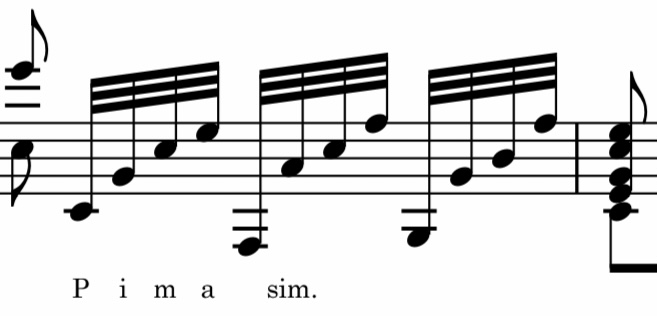
The advantage of the technique of planting is the contact of the fingers with the string, and the resulting certainty of the stroke: the string cannot be missed. We can also consider string dampening as an advantage, which affects the clarity of phrasing. However, beginners should avoid a common mistake, which is irregular arpeggio, usually associated with wrist movement. The wrist must remain still during playing and must not bounce. Once we master the pima arpeggio, we can also use planting for arpeggios of three fingers, in combinations such as pim, pia, and pma. However, the time when the fingers are placed on the strings is significantly shortened here.
Planting is commonly used only for ascending arpeggios. However, we can easily change the direction of movement and play in inversion. It may take quite a short time for the hand to adjust, but this allows playing with preparation for arpeggios such as pami, pmi, and pai. This can be utilized, for example, in the seventh movement of Falla’s Siete Canciones Españolas, where the pami arpeggio is played in fast thirty-second notes.

We could easily find many similar examples; the technique of planting can be used in most pieces of the guitar repertoire.
So, does this technique have any disadvantages? The main disadvantage is that this method cannot be used for playing on a single string or when playing scales. Also, since planting has greater speed potential than playing with a normal stroke, it is necessary to maintain rhythmical regularity. Another disadvantage is that during playing with preparation, the finger does not execute the stroke in its full width, there is less contact of the string a nd the fingertip during the stroke. This contrast between playing with and without preparation can lead to negative effects, such as hand stiffness. Some guitarists, therefore, do not use planting at all or only rarely. A stroke without preparation, if performed correctly, relaxes the muscle groups of the finger during the backward movement. Additionally, an arpeggio played without preparation allows all strings to resonate, approaching the sound of piano playing with pedal. However, the disadvantage of a stroke without preparation is the higher error rate in movement, resulting in unintended playing of higher or lower strings. This also clearly shows which technique the guitarist is using when playing arpeggios. Therefore, I believe that it is ideal to master both playing with preparation and without preparation, and to use them with respect to the musical intention of the composer. Using planting is faster, but I recommend practicing all arpeggios played with and also without planting. Slower fingerings thus learn from faster ones, which is one of the pillars of my method.
In conclusion, Štěpán Rak also recognizes a supported stroke, which is similar to playing with preparation. During arpeggio playing, another finger is placed on the next string simultaneously with the stroke of one finger. This stroke can be found, for example, in Rak’s composition Dance around a linden tree (Vůně Lípy).
 Josef Mazan