While browsing through Dionisio Aguado’s Method published in English translation in the Tecla edition (Tecla 0011), I came across a specific fingering of the right hand in his well-known Study No. 17 (fig.1, page 130).
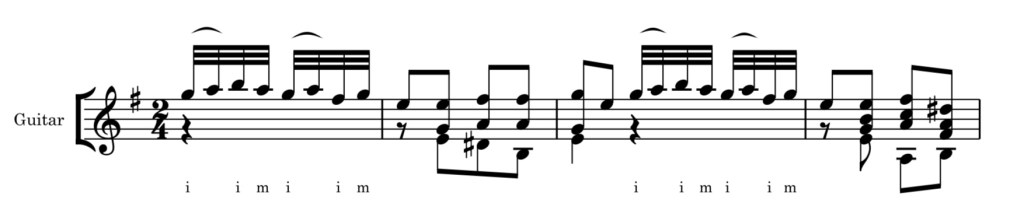
It’s Aguado’s original fingering, and it may seem controversial as it seemingly goes against the rule of alternating fingers. However, through studying the Method, I’ve realized that it’s not a mistake but a deliberate concept. Similar occurrences appear frequently in many other parts of the book, such as in exercise 24 on page 88 (fig. 2).

I tested this idea on my own sequence. Aguado’s fingering i-m is much more regular in sound and much easier and faster for me than the mechanical fingering i m i m which I learned from the conservatory. The latter places accents on different fingers each time, shifting the model of three notes when using two fingers of the right hand, which can lead to stiffness in the hand and slowing down the tempo (fig. 3).

Aguado used this fingering even when playing two-octave scales (fig. 4).
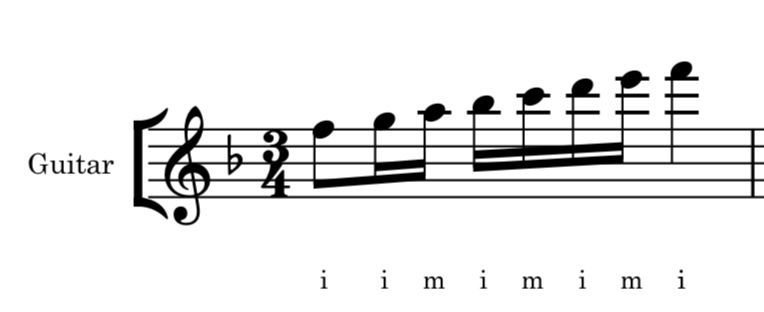
He often starts the scale with an eighth note, followed by sixteenths. The first note played with the i finger serves as a psychological preparation, activating the fingering formula, as one of my teachers Prof. Zelenka used to say. Additionally, it serves as a warm-up, similar to the bouncing of athletes before starting the run for a high jump.
Aguado’s fingering is not suitable for every case, but it’s a valuable contribution to solving the problem of string crossing. I would recommend everyone to try exercise 79 on page 105 of the Method (fig. 5).

I transposed it down an octave, but I learned it in all keys and positions on the guitar. In the right hand, it leads to an exceptional calming effect and reinforces the regularity of the stroke.
We can make sure that each group with a legato at the beginning always starts with the i finger, which has a beneficial effect on memory and audibly affects the precision of articulation. Playing with a half-stroke is particularly effective. Recently, during an online consultation, I learned that Prof. Carlo Marchione knows, uses, and teaches this Aguado’s fingering to his students.
 Josef Mazan