People with good musical ears can sing in tune. Others may struggle with intonation. This article discusses how to improve and sing more accurately. Singing with precise intonation is essential for understanding musical compositions. For instance, when studying the works of Johann Sebastian Bach, it’s beneficial to be able to sing each voice of the counterpoint. Singing is also helpful when studying the basso continuo, where it’s advantageous to sing the bass while playing the remaining three voices on the guitar. This allows for greater freedom of movement in the tenor, alto, and soprano. Jazz musicians can typically sing every note they play. This skill is excellent for deepening one’s orientation in the musical space.
Let’s start with singing along with the open sixth string of the guitar. When we play the note E, its overtone series ring simultaneously, producing tones E, B, E, G♯, B. The series continues further, but we’ll focus only on the first five tones since the others are very weak. The note E will serve as our reference point for singing intervals. Each sung note also has its own overtone series, in the same ratio but from a different fundamental tone.
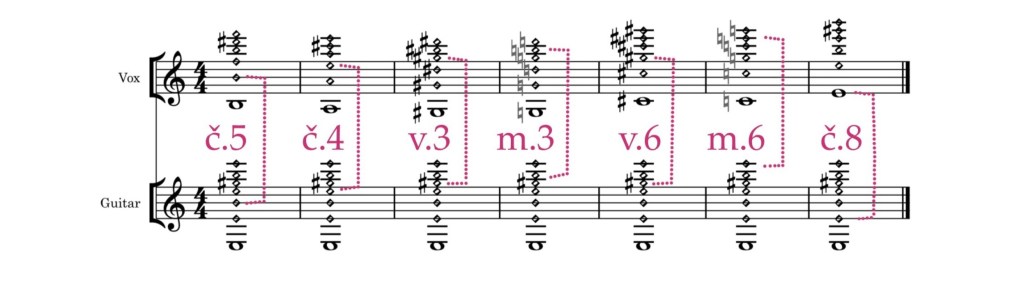
My method of accurate intonation is based on finding the lowest tone common to these two overtone series. For the perfect fifth E to B, the common tone is B. For the perfect fourth E to A, the common tone is E. For the major third and major sixth, the common tone is G♯. For the minor third, the common tone is B. For the minor sixth, the common tone is E.
The intervals with a common tone as low as possible can be intonated most accurately. If we arrange intervals according to the ease of intonation, we get the order: perfect octave (1), perfect fifth (2), perfect fourth (3), major third and major sixth (4), minor third (5), and minor sixth (6). The number in parentheses indicates which tone of the overtone series is common, as seen in the illustration. Therefore, the most challenging interval is the minor sixth, which has the most distant common tone.
Our goal is to experience the sensation when the bass and the sung tone „lock in“ together. This occurs when their overtone series intersect at a common tone, where they fit together. If we intonate precisely and evenly, a special synergistic phenomenon occurs, which musicians call „locking in.“ When two tones forming an interval fit together, they create a beautifully intonated interval pleasing to the ear. Octaves and fifths fit together best, followed by fourths. Thirds and sixths also fit together, but it requires a refined ear to notice. This is what Fernando Sor and Dionisio Aguado had in mind, in my opinion, when they emphasized student’s imagination of intervals of thirds and sixths in their methods. I believe their intention was for the student to develop their ear. To hear the difference between a minor and major third, to understand how the overtone series of these intervals fit together. In those times, every musician was also a composer. If you were learning to play a musical instrument, including the guitar, you also had ambitions to compose. And I consider that to be a way forward even today, something my students and I strive for. To cultivate a sense of musical form, a good ear, and the creativity to compose their own pieces and variations.
So, for anyone looking to improve their intonation, I recommend singing these intervals daily. It’s good to be aware of the common point of these two overtone series, and especially in the beginning, to play it often. After a short time of a few weeks of practice, significant improvements will be noticed. We will know what a perfectly intonated interval sounds like, and we’ll be able to sing accurately without conscious effort.
 Josef Mazan