Playing the guitar with nails is a relatively new phenomenon. Up to the time of Fernando Sor, most players played without nails. Playing on double-course lutes and similar instruments was complicated with nails.
Right at the beginning, however, I would like to clarify one issue. We do not use nails to create a beautiful tone. We influence the tone’s color with the fingertip of the playing finger. The nail is an obstacle that we must overcome for the string to leave the finger and resonate. This causes the string to stretch longer, resulting in a stronger tone. Also, the composition of the overtone series of a tone created without a nail is different. The tone without a nail is velvety muted, as if veiled, with a predominance of the fundamental tone and the first harmonics of the overtone series. The tone created with a nail allows the higher harmonics to resonate, it is sharper, brighter, and more resonant. Also, thanks to this, it enables playing sul ponticello, which does not sound clear enough without nails.
Much has already been written about what shape of nails is suitable. To those interested I can particularly recommend the excellent book „Pumping Nylon“ written by Scott Tenant.
However, I was more interested in the method of filing nails used by the famous Paco de Lucia. He placed sandpaper under the strings and then moved his fingers as in normal play. The nails would get ground down, creating a flat surface. What’s fantastic is that this flat plain corresponds to our personal ways of creating the tone. There is no need to scrutinize anatomical differences in hands or various ways of holding the instrument. No. Our individual way of producing the tone creates a flat surface on the nails, which may be different for different players, and its angle may vary.
It might be clearer in the pictures. I assume we’ve let our nails grown to have material to work with (fig.1).
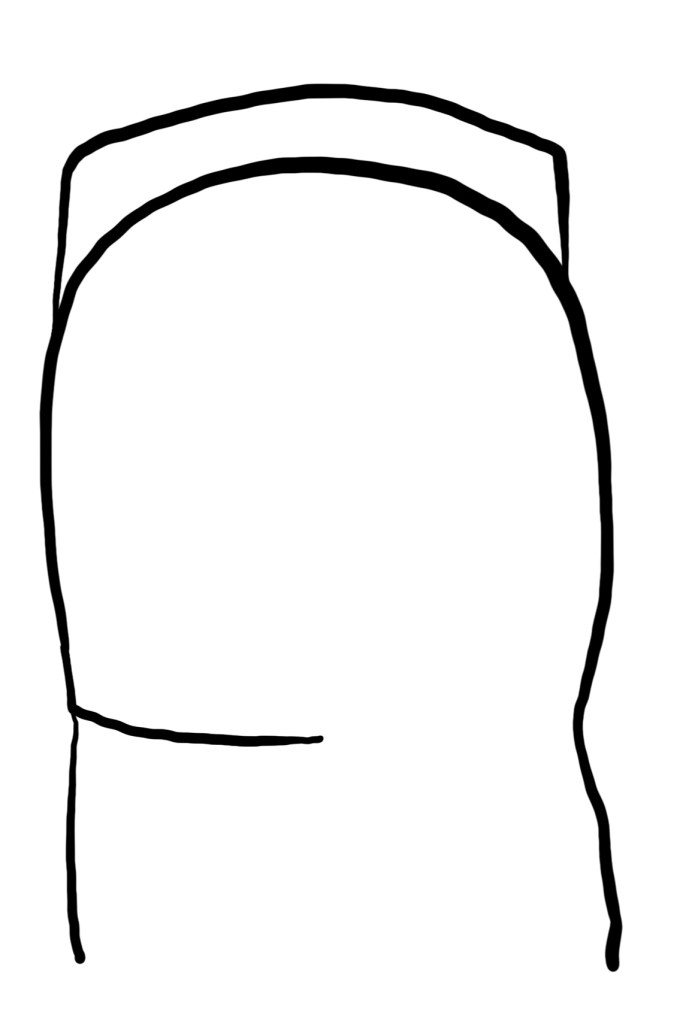
Then we prepare sandpaper or a file, which we put under the strings, on the fingerboard (Caution: If we play in the normal position of the right hand, the nails will be ground down too much, and it will take several days for them to grow back. I recommend lowering the wrist towards the soundboard, changing the angle of the finger movement.) The quickest way to grind them is with a double-sided rasgueado of each finger. Playing apoyando is also effective. When we feel that a flat surface has been ground well, we can look at the result of our work. We should see something similar to the image (fig.2).

In the next stage, we round off the edges at the beginning and end of the flat surface. So that a rounded shape is created, mirroring the shape of the fingertip. There are other methods of shaping nails that extend this flat surface along the entire length of the nail. This may not be a bad idea, but such nails are easily broken. A rounded surface is sturdier and more resistant to impact. After rounding, we obtain the nail shape seen in the picture (fig.3).

I denote the string impression on the fingertip with the letter a (see my article here on creating a tone). As we can see in the picture, the string is located where the stroke begins. Then, as the finger moves towards the palm (it is the opposite way for the thumb :), the string travels along line b, up to point c. Here, the string leaves the finger. However, it is desirable for it to be touching both the fingertip and the nail, when leaving. This requires experimentation to find the right shape and length of the nails. Also, the position of the right hand and the height of the guitar’s head relative to the player’s eyes affect these things and can be experimented with, changing the angle, raising, lowering. Till we achieve a tone that satisfies us and allows us to convincingly express the musical idea of the composition.
Another important point is the perfect smoothing of the nails. It is performed in two planes, as we can see in the picture (fig. 4). First around the entire length of the nail on plane a, then on the bottom of the nail, on plane b. Both planes must be smooth, but plane b is more important because it will touch the string longest during the stroke.
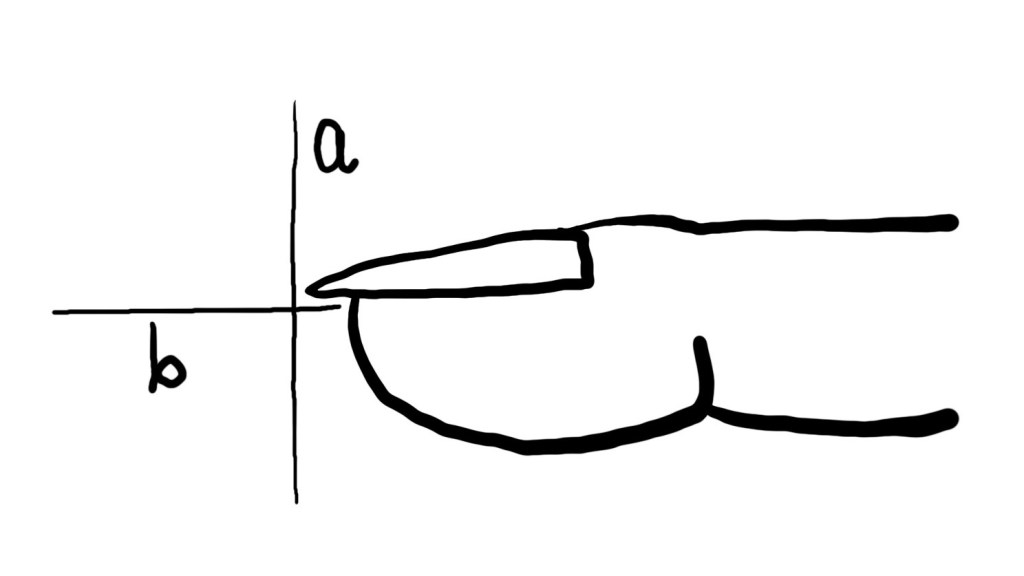
To file the nails, I first use a glass file for the roughest treatments and a metal file for finer ones. Then I smooth the nails with a fine file that has three steps. They are graded according to the hardness of the sandpaper, the third part is only used for smoothing and polishing the nail. Then I check the nail, it must be smooth to the touch and without the slightest crack.
In conclusion, it should be mentioned that when playing registers and different positions of the right hand, the angle at which the string leaves the finger can change. Therefore, if we want to be consistent, we can file the nails from multiple positions and obtain multiple flat surfaces on the nail, which will guide us even more precisely to the ideal nail shape. Once we find the suitable nail shape, we can simply maintain it, so it is not necessary to perform the described method every day. However, until we find it, it seems to be an objective method that can show us the way.
 Josef Mazan
Napsat komentář