Tremolo is one of the cornerstones of guitar technique. It is possibly the first step towards advanced playing techniques. The reason is that tremolo involves playing with multiple fingers of the right hand on a single string. Therefore, it is necessary to minimize the contact of the finger with the string to allow enough time for the tone to resonate before the next stroke occurs. At a slow tempo, when there is time to work on the tone color with longer contact of the right-hand finger on the string, we use a different type of stroke. In tremolo, the finger moves as quickly as possible, with a flick.
If we learn this type of movement, we have opened the path to higher playing techniques, to fast scalar passages, arpeggios without preparation, and playing Bach’s counterpoint.
Over time, it has become customary for many guitar teachers to begin studying tremolo with the piece „Sueño“ by José Viñas. As a footnote, it is interesting to note that in the original version of this piece, there is no tremolo at all. However, we feel that „Sueño“ calls for tremolo, it suits it very well, and it is inherent in the piece.
We therefore work with arrangements of this piece. In my opinion, the most suitable is the basic tremolo in triplets (see Fig.1).
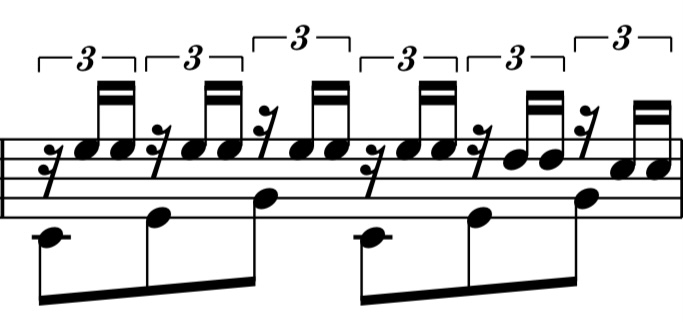
Tremolo here can be performed with the fingerings pim or pmi. One of them is usually easier, stronger, and fits better with the fingers. Which one is very individual. My method of teaching tremolo is that the student first plays, say, for a week with the fingering pim, and the next week with the fingering pmi. If the student is more advanced, the fingerings can be alternated within the piece. One possibility is: one full measure with pim, the next measure with pmi. Even more difficult, but very effective, is the method of alternating fingerings within one measure, pim pmi pim pmi pim pmi. After some time of such practice, the stroke accuracy improves. The student can verify which fingering is more suitable for their hand. The weaker fingering simultaneously learns from the stronger one, which is the basis of my method of guitar playing instruction and leads to balanced strokes.
The method of alternating two fingerings within one arpeggio (tremolo on the guitar is an arpeggio on one string) is not entirely my idea; it is derived from the compositions of Mauro Giuliani, for example, from Prelude No.1, Op. 83 (see Fig.2). Here we see the alternation of fingerings pima pami pima pami within one measure.
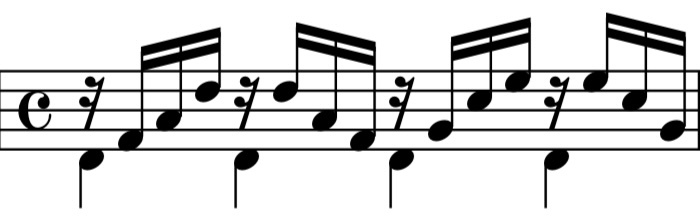
When playing tremolo, however, this fingering is more demanding, as we cannot simplify the play by using planting, which is not possible on one string.
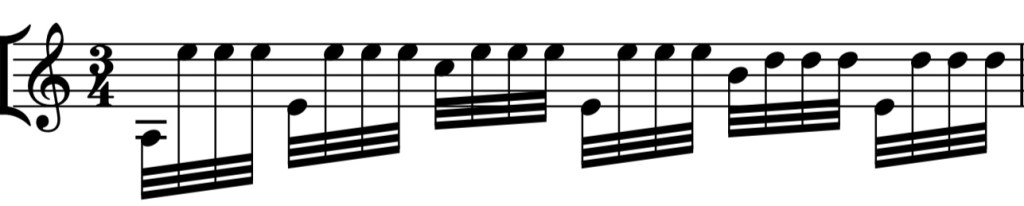
Once the student masters „Sueño“, they can proceed to study Tárrega’s „Recuerdos“. Here too, I derive from Giuliani’s Prelude No.1. Alternating fingerings pami pima within one measure leads to regular strokes and more precise finger movements (see Fig.3).
As I was a student of Prof. Štěpán Rak, it is only natural that we expand the fingering pami to a quintuplet pcami. Here too, I recommend alternating fingerings pimac pcami within one measure, or one full measure with one fingering and the next measure with the other fingering. Thirty-second note triplets in ornaments change in this variation, within the framework of the same repeated quintuplet (see Fig.4).
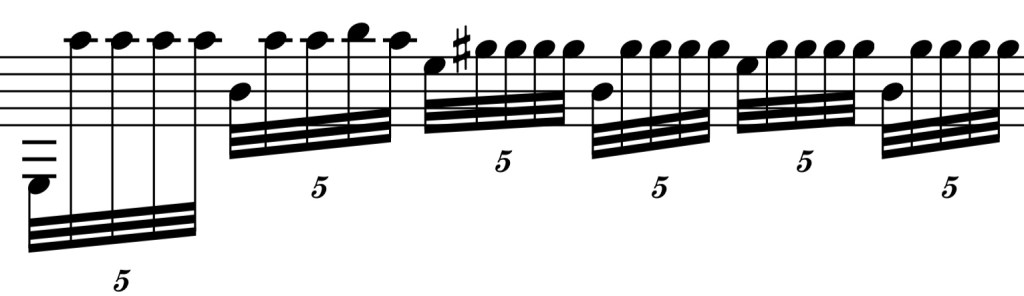
This method is very beneficial in studying tremolo and significantly shortens the time necessary to master it safely.
 Josef Mazan
Napsat komentář