PLAYING THE GUITAR
A love of music is very important for learning to play a musical instrument. I feel that it goes hand in hand with understanding the compositions we study. The way of teaching the guitar has changed a lot during the historical development. For today, the orientation towards competitive performances is characteristic. There is less time to study songs in depth. Creativity has almost disappeared, few guitarists compose their own compositions. A contrast to the modern approach can be the way the guitar was taught in Paris around 1820. The greatest emphasis was placed on individuality, every guitarist was also a composer. During the artistic meetings, great emphasis was placed on variation development of the theme, on improvisation.
This creative approach is very sympathetic to me and is still my great inspiration. I have therefore developed a method over the years that emphasizes creativity. We study compositions with my students in greater depth. It is important to transpose selected parts of compositions, understand harmony, phrasing, rules of melody construction, form and musical tectonics. This naturally leads to the desire to write own compositions, first variations. Variations are suitable for the beginning because they lead to a different grasp of the theme, to the search for motifs, to their development, to connecting parts into larger wholes. A creative approach to music can be applied from the very beginning. Our example can be piano lessons, where transposition of compositions is also often used already during the first year of study.
As far as technique is concerned, it is very important to create the correct tone. The position of the hands while playing, holding the instrument and other things depend on it. Examples of great guitarists, such as Vladimír Mikulka in our country, are an inspiration. But the most important thing is competing with yourself. Everyone has certain personal dispositions, some techniques are easy, others can be more difficult. My method is based on the fact that the weaker fingers learn from the stronger ones. Pima fingering can be learned from pami, legato 2-3 from legato 1-2, scales played with fingering can learn something from pi fingering. The goal is the unification of technology. One’s own limits are overcome. Not by imitating recordings, but by learning on your own.
I supplement my guitar playing with a practical study of numbered bass. This naturally leads to a deeper understanding of music, to overcoming thinking in guitar fingers! Psychological preparation for the performance is also an important aspect. There are many great guitarists who are nervous about playing in front of an audience. But there are methods to work with stage fright. On the contrary, if we work with stage fright in the right way, much higher levels of spirituality and a much more sensitive interpretation can be achieved thanks to it. In these matters, I was greatly influenced by the Conscio Method, which can prepare top athletes for top performance. I also draw from my personal experiences, especially from concerts in Japan and Paris.
The basic ideas of my method can be summarized as follows: Compete with yourself, learn from yourself. Express your soul through music. Compose!
GENERAL BASS
The general bass is somewhat similar to playing chord marks, but it goes much deeper. It is a tutorial on how to improvise based on the harmony expressed by the bass. But it is improvisation under constant control. When playing a numbered bass, you must always keep track of the distance between the voices. Thanks to this, we will understand the meaning of sixths, fourths and other intervals in chords. The bass is the reason why baroque music is so well written. Johann Sebastian Bach, the grandmaster of the bass, is also popular among jazz musicians. His music is full of unrestrained invention. To open this invention, the knowledge of the general bass is also used. Playing bass guitar can be difficult. An excellent study method is bass singing with simultaneous improvisational playing of soprano, tenor and alto on the guitar. I believe that understanding the bass guitar is important to understanding the contrapuntal fabric of music from past eras.
PSYCHOLOGICAL PREPARATION
A classical guitarist should be aware of how the interpretation process works. When we are on stage, our main task is not to obstruct the flow of energy and music. When rehearsing compositions, it is advisable to start from proven methods and rules, which include, for example, visualization, playing with closed eyes and transposition. There are also many other exercises that lead to overcoming stage fright and finding the inner balance necessary for quality artistic performance. At the same time, these exercises strengthen the inner imagination.
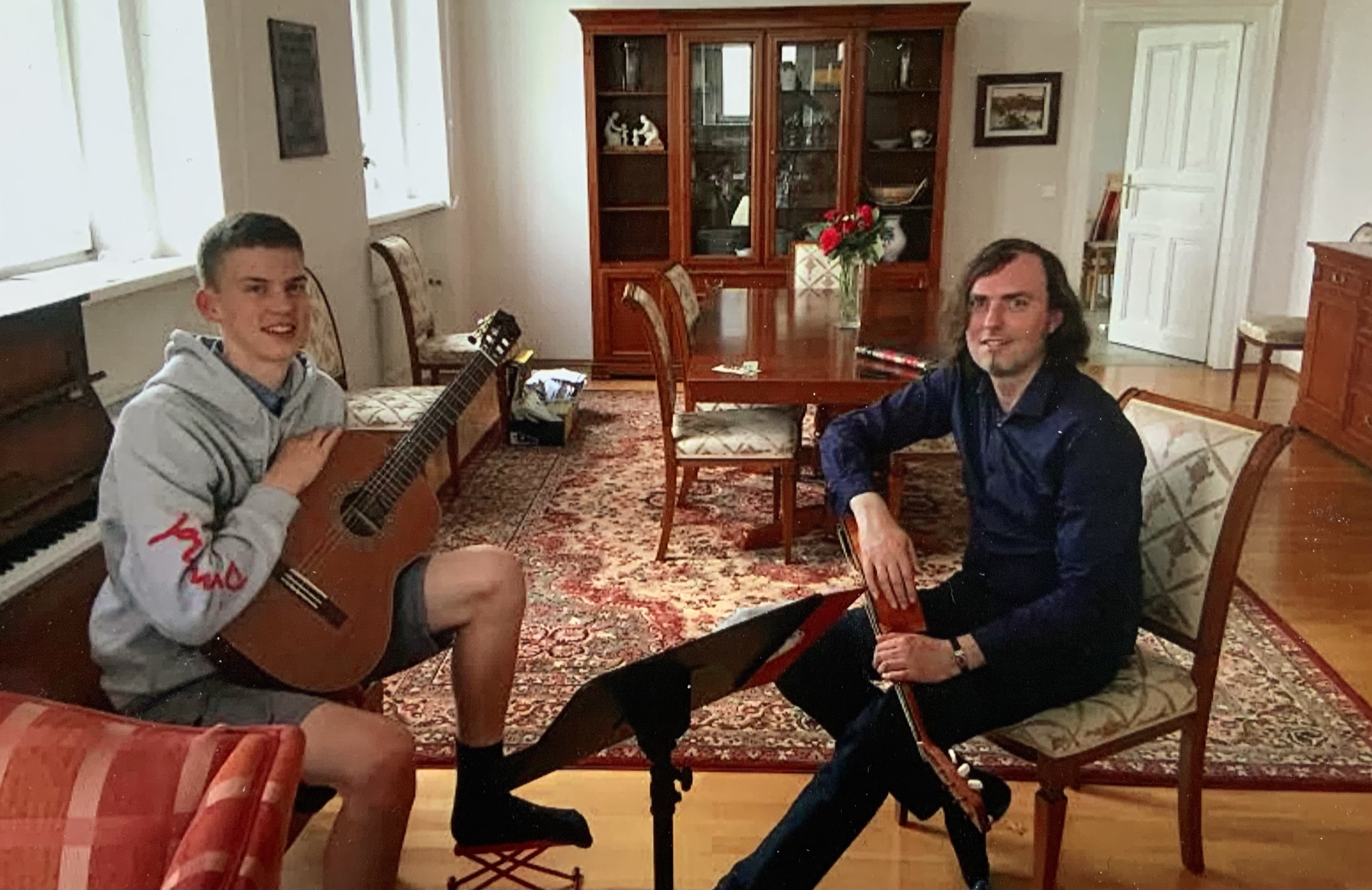
 Josef Mazan